

User Interface
Bamboo Village
All characters begin play in a small, quiet village, hidden in the mountains. Bamboo Village is a safe haven for vagabonds, who are aspiring kung fu masters who have not yet pledged themselves to a clan. By the time you leave Bamboo Village, you'll have passed from the Losing Self step to Gathering Chi, you will know a few basic kung fu techniques, and you'll be ready to select a clan to join.
The inhabitants of Bamboo Village will help introduce you to some of the various aspects of the game. You can also press F1 to access the in-game help function. If you miss or forget a lesson, or you just can't wrap your head around what the villagers are saying, this guide will go into more detail, and cover some topics missed by the villagers and in-game help.
Basic UI
The User Interface , or UI, is how you monitor information about your character. There's a lot of information here, so we are breaking it into sub-sections, and briefly describing the function of each. Later sections will go into more detail on these functions.
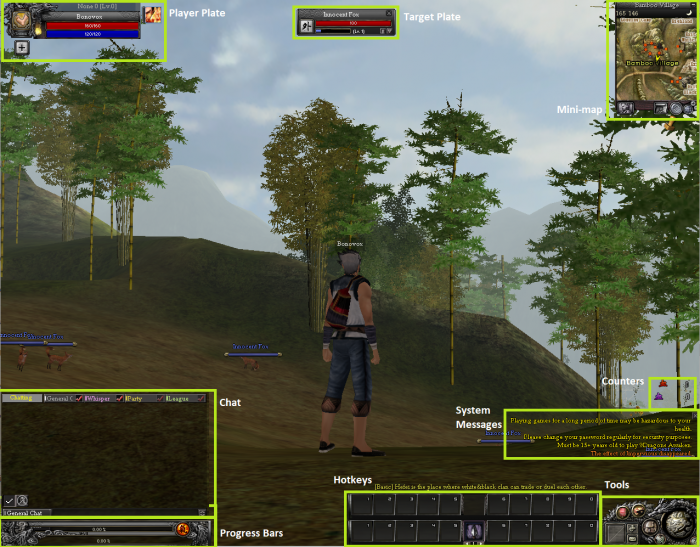
Player Plate
Vital information about your character is displayed here.
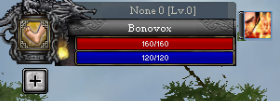
The top bar is your character's current Stage and Cheng, which correspond to level (also displayed). Below is your character's Name.
The red bar displays your character's Life or HP. If you suffer External Wounds, are displayed as a number on the bar's right.
The blue bar displays Vital Energy, needed to perform kung fu. Internal Wounds are displayed similarly to External. If you move the mouse over the bars, you'll get a full readout of your character's Stats.
The icon on the left of the bars displays your character's Role. To the bars' right are Buffs and Debuffs - temporary effects which increase or decrease your character's combat ability, respectively. Moving your mouse over a buff or debuff usually provides more information on it.
The “plus” icon indicates that your character has unspent Attribute and/or Mastery points.
Target Plate
The Target Plate is similar to the Player Plate, but it only displays remaining HP, and only as a percentage.

The bar below HP indicates the target's level, and how powerful it is relative to you. If the colored block is to the left, then the target is weaker than you are, whereas right means stronger. If the block is in the middle, then the target is roughly as powerful as you.
You can't see your target's role, but the icon displays the target's Clan if they are an enemy, or their function if they are an NPC (such as a blacksmith or herbalist).
Clicking the X indicator deselects your current target, and closes the Target Plate.
The left button in the bottom-left corner is the Character Information request. If you wish to view another character's equipment and/or attributes, you can request to do so. But anyone who agrees will be able to view your information as well.
The right button, Character Menu, opens a list of multiple commands, all of which will be described elsewhere in this guide.
Chat
Chat by you and other Nine Dragons will be displayed here.
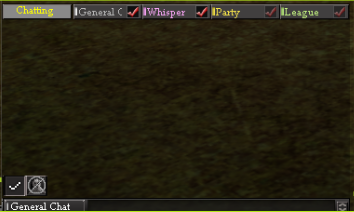
Clicking the top row Chatting button will toggle hide the remaining buttons in the row, unless you mouse over them. Checking or un-checking the boxes will display or hide chat messages from the respective channels.
The button with the checkmark icon will hide/display System Messages, which are displayed elsewhere on the screen.
Next to the checkmark is the Blacklist, which allows you to add or remove other players from your blacklist.
The button named General Chat is the default chat channel. The default channel can be changed here.
To the right of the chat input bar is Expand Window, which increases the chat window's size.
Progress Bars
These bars display your current Anger and Experience levels. The orange button to the right of the Anger bar activates Berzerk, if Anger is already activated.

Hotkeys
Your available kung fu and chi kung techniques are displayed here, corresponding to the Number Key you can press to activate them. Pressing the number key alone activates the lower bar, and pressing Ctrl plus the number key activates the top row.
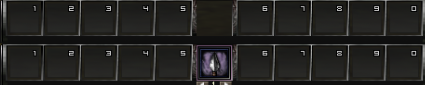
The icon in the middle of the bottom bar indicates whether your are in Peace Mode (grey), Combat Mode (orange), or engaged in Player-versus-Player (PVP) combat (red). The number below it indicates which of your three saved hotkey sets are active.
The middle of the top bar displays your Lightfoot technique, which can be used without a hotkey.
Mini-Map
The area near your is displayed here. Above is the name of your current Map/Zone. You can hide the Mini-Map by clicking the icon to the right of the Zone name.

The next bar down displays your Co-ordinates - your precise location for that map.
The moon icon indicates the time of day (day/dusk/night/dawn). It will change as time passes, and some skills are affected by the time of day.
On the bottom row of grey icons, the leftmost icon lets you Find an NPC in the current map, if you need a particular NPC service.
To the right is Location track list display, which lets you locate hostile players in PvP.
Resize Map expands the Mini-Map to about ten times its normal size. This might interfere with your gameplay, so an Opacity slider also appears on the expanded map.
World Map displays all Zones in the Land. You can click each Zone to get even more information on it.
Zoom In and Out increase or decrease the Mini-Map's display size.
The stamp icon below the Mini-Map opens the Cumulative Event reward screen.
TIP: The Mini-Map and Target Plate can both be dragged to different locations on the screen.
System Messages and Counters
System Messages are text messages not typed by players - information on the game's functions, your own techniques, and important info. It can be hidden with the X icon.
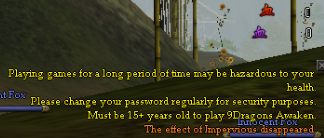
The Blood Point counter increases as you kill monsters, and resets if you are killed. 999 Blood Points reward you with one Blood Essence, a useful trade item.
Ironblood Points also increase and can be exchanged for points, once you reach a certain high-level map.
Tools
Various utility functions are located here.
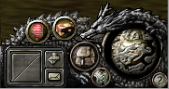
Meditation places you into meditation mode, and displays which type of meditation is active.
Messenger sends chat messages to select individuals or groups who are logged in to the game.
Pigeongram lets you send messages, even to offline players.
Bags opens all equipped bags, displaying the items your character is carrying.
Information opens the Information Window, where most data about your character is found.
Options allows you to further customize the game's settings, or to log out of your character, the server, or the entire game.
Help opens the in-game help tool, which displays information on the game, organized by topic.
Other Windows
Pressing F11 opens another screen, with various advanced features which are covered elsewhere on this wiki.
Next: Moving and Interacting